

“An incubator for ideas and partnerships”
During Geneva Peace Week 2025, the Peace and Human Rights Division (PHRD) and the Swiss Agency for Development and Cooperation (SDC) will be holding panel events to present innovative approaches to reducing geopolitical tensions and strengthening preventive measures. In this interview PHRD Head Tim Enderlin and SDC Director General Patricia Danzi emphasise how important international cooperation is for security and peace.
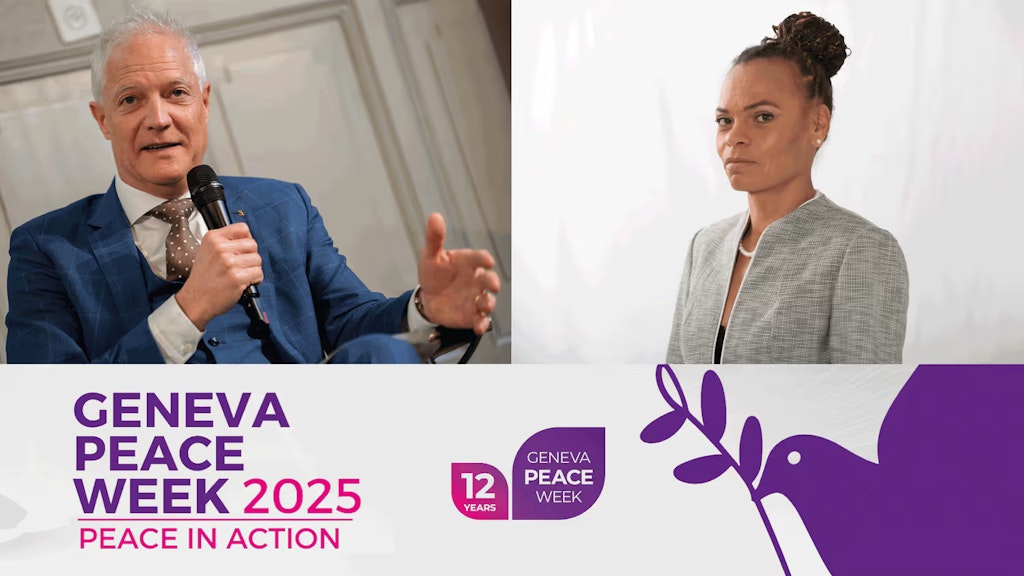
The Geneva Peace Week 2025 (GPW) will unfold from 13 to 17 October 2025. With its motto Peace in Action, the GPW's 12th edition has adopted a forward-looking approach to peacekeeping. In the face of complex crises and growing financing gaps, new perspectives and innovative solutions are needed. The Swiss Agency for Development and Cooperation (SDC) and the FDFA's Peace and Human Rights Division (PHRD) are organising various panels on this topic. Among other things, the focus is on translating national prevention initiatives into sustainable peace structures, strengthening synergies between peacebuilding and human rights, water diplomacy, and coherent and rights-based approaches to prevention and peacebuilding.
In this interview, SDC Director General Patricia Danzi and PHRD Head Tim Enderlin talk about the challenges of international peacebuilding, the role of Geneva Peace Week and the opportunities it presents.
Geneva Peace Week
Geneva Peace Week (GPW) is an annual international forum in Geneva that brings together experts, diplomats, international organisations, and representatives from academia, the private sector and NGOs. The aim is to share knowledge and experience on a variety of peace issues in different contexts and disciplines. The week is organised by the Geneva Peacebuilding Platform in cooperation with the UN, the most important peace organisations in Geneva, the Swiss mission, international organisations and local partners. The motto of this year's Geneva Peace Week is Peace in Action. It aims to promote adaptive, inclusive and collaborative approaches to peace and emphasises the urgency of cementing dialogue with concrete action.
How would you assess the importance of the SDC's and PHRD's participation in Geneva Peace Week?
Patricia Danzi Peace and good governance form one of the four development goals of Switzerland's international cooperation strategy. This is both a prerequisite for and the result of sustainable development based on social security, the rule of law, human rights and democracy. By actively participating and organising two events, the SDC is underlining the importance of this topic for its work and at the same time making use of this global platform in International Geneva.
Tim Enderlin: Geneva Peace Week is an incubator for ideas and partnerships. It brings together actors from diplomacy, academia, civil society and multilateral organisations – precisely the ecosystem that makes Geneva unique. For us, it's more than just an annual conference: it's a sounding board allowing us to identify trends, forge alliances and test innovative approaches.
To what extent is Switzerland active in the field of peacebuilding as part of its international cooperation (IC)?
Enderlin: The 80th anniversary of the UN comes at a time when multilateralism is under great pressure. Rivalries between major powers, obstructed decision-making processes and dwindling trust are taking their toll on the system. At the same time, the UN80 Initiative launched by the UN Secretary-General presents an opportunity to revitalise multilateralism. For us, this means consistently promoting our peace policy priorities – dialogue, prevention and human rights. Around a year ago, the Pact for the Future confirmed the need for an inclusive, nationally led approach to prevention. Switzerland is committed to ensuring that reforms improve the UN's ability to take action and that multilateral cooperation is once again perceived as a guarantor of security and stability.
What role does the international community play in implementing the Pact for the Future – for example Switzerland?
Danzi: The Pact for the Future is a commitment by the international community to greater cooperation. It is based on the recognition that the major challenges of our time can only be solved by working together. An everyone-for-themselves jungle will not lead to greater security and peace. As a small, successful, export-oriented country, Switzerland has a keen interest in a world order based on international law. On peace, the pact encourages countries to take their own national measures. When countries threatened by instability and conflict push for peacebuilding and conflict prevention on their own initiative, the prospects for success are notably better. But this also means that donor countries need to pay close attention to what is likely to succeed. Switzerland has long pursued this approach, based on local needs and the principle of ownership and dialogue on equal footing – and we aim to reinforce it in international cooperation worldwide. Ultimately, we are convinced that this will not only make our work more successful, but also more cost-effective. It is usually more expensive and painful to rebuild after a crisis than to avert crises in the first place.
In what areas does Swiss international cooperation make truly tangible contributions to promoting peace?
Enderlin: Mediation is a cornerstone of Switzerland's peacebuilding work. The PHRD offers its expertise to the parties to help them resolve their disputes. It can provide a confidential framework for holding talks and/or methodological support for negotiators. Common examples include Switzerland's activities in the Sahel or Sudan, support for a peaceful transition in Syria, and support for peace processes in Colombia. It offers its good offices to support these processes, or even to host them in Switzerland, particularly in Geneva.
Danzi: The SDC also focuses on supporting countries as regards good governance, i.e. reforms of government and institutions as regards the rule of law and work to improve public services that facilitate democratic processes. The SDC also backs attempts to re-establish dialogue in conflict-striken societies. Lastly, the protection of minorities and disadvantaged communities is also a focus of our work.
Increasing geopolitical tensions, ongoing crises and political instability in various regions of the world have also led to uncertainty among the Swiss population this year. What dangers do current international developments pose for Switzerland – and to what extent do we need to think more holistically about the concept of security in future?
Danzi: Switzerland already doing that. It is no coincidence that in Article 2 of the Federal Constitution, the Confederation's duty to safeguard Switzerland's security is listed alongside its commitment to the long term preservation of natural resources and to a just and peaceful international order: a collapse of the rules-based international order would endanger the foundations of Switzerland's success, i.e. dialogue, trust, stability and global trade.
International cooperation plays a key role in maintaining a rules-based world. But today, pressure on such rules is sapping their strength. The law of the jungle has gained ground. It is in Switzerland's interest to counteract this trend at international level, and with International Geneva, our globally recognised neutrality and as the depositary state of the Geneva Conventions, we can contribute to this end.
Enderlin: Increased polarisation threatens all states that, like Switzerland, need a world order governed by rules. Another danger is the erosion of the normative framework, in particular the UN Charter and international humanitarian law. Lastly, the emergence of new technologies and their use in armed conflicts, outside the legal framework, is radically changing how we think about security. Our understanding of future security challenges must combine analysis of new threats with constant adaptation of traditional peacebuilding instruments.
For a country like Switzerland, it is important to approach security in a comprehensive, inclusive and humane way, and to adopt an approach that goes beyond the military dimension alone. Today's threats – incessant conflicts, climate change, inequalities – require an approach focused on people and the resilience of societies. For a country like Switzerland, security is based less on power than on dialogue, prevention and cooperation.
How, specifically, does Switzerland help promote peace and security? Can you name some examples?
Enderlin: The PHRD promotes peace processes and conflict resolution through dialogue at all political levels. These processes are as unique as the conflicts themselves: in the Sahel, the PHRD is carrying out a mandate received from the key regional actor Niger to support a mediation process between it and its neighbours.
In Sudan, the PHRD has created a confidential and informal platform for dialogue between the political parties, polarised by the war and the humanitarian crisis, in order to help establish a shared political framework for post-war Sudan. It also supports and participates in exchanges between the powers that have influence over Sudan in order to facilitate humanitarian access there – within the ALPS Group (Aligned for Advancing Lifesaving and Peace in Sudan). In Colombia, at the request of the government and the armed groups, Switzerland is the official guarantor of three negotiation processes.
In other contexts, the PHRD provides expertise to support the formation of a national system to deal with serious violations of human rights and international humanitarian law during a conflict; dealing with the past is an important step in a society's ability to rebuild peaceful coexistence.
Danzi: One example of our work at the state level is our support for DCAF, the Geneva Center for Security Sector Governance, which helps ensure that security-related institutions such as the police, military, and judiciary operate transparently, respect human rights, and can be held accountable.
A local example comes from Mali, where over 3,000 women have gained knowledge, self-confidence and a stronger voice via the Peace Circles project. They support victims of violence and act as bridge-builders in their towns, and this strengthens social cohesion and creates security in the local communities.
In your view, what role does International Geneva play in peace and security issues?
Enderlin: International Geneva is and remains a cornerstone of Swiss peace policy. Its unique ecosystem – the density of international organisations, research institutions and civil society actors – creates a critical mass that promotes exchange, innovation and new approaches to peace.
The Geneva Peacebuilding Platform, the main organiser of Geneva Peace Week, plays a key role in this: it connects actors from all areas and has made a significant contribution to deepening knowledge and understanding of peacebuilding. Geneva thus remains a place where ideas are translated into concrete action and multilateral cooperation is practised on a daily basis – a role that the Federal Council recently expressly reaffirmed with its decision to strengthen International Geneva.
Peace and security
‘Peace and security’ is one of the thematic priorities of Switzerland's Foreign Policy Strategy 2024–27. Peace and security form the foundation for prosperity and sustainable development; conflicts not only have local consequences, but can also have a direct and indirect impact on Switzerland and affect aspects such as security, the economy and migration.
FDFA Communication
3003 Bern