

International criminal justice
International criminal courts prosecute individuals accused of serious international crimes, such as genocide, crimes against humanity, war crimes, and the crime of aggression. Switzerland strongly supports the International Criminal Court and considers it a significant step forward in the fight against impunity and for respect for international humanitarian law and human rights.
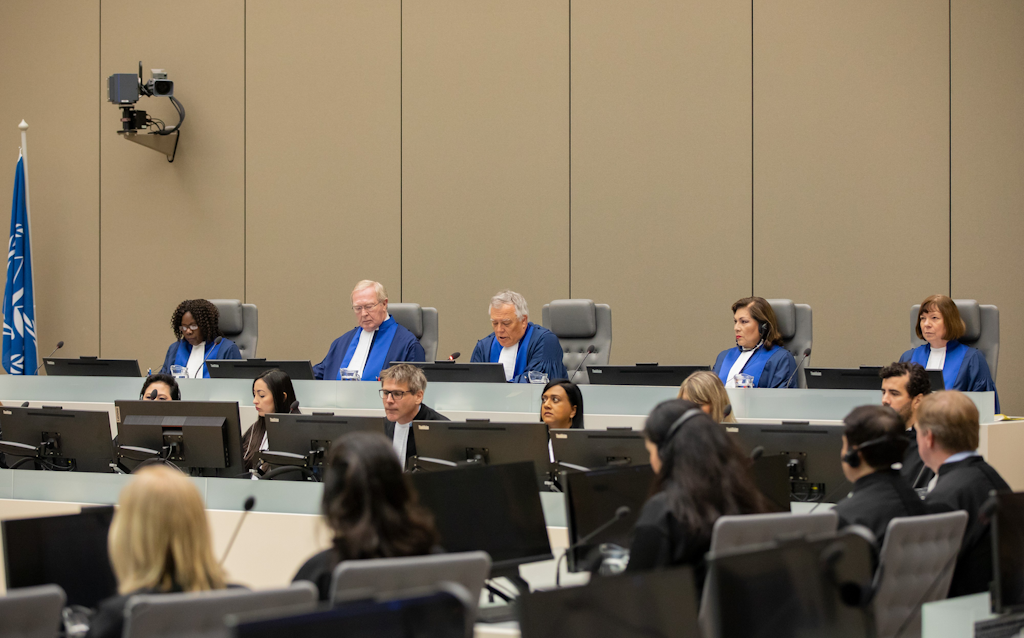
International Criminal Court
The establishment of the International Criminal Court (ICC) is a milestone in history. Its foundation is the Rome Statute of 1998, which entered into force on July 1, 2002. The international community thus has a permanent judicial authority accessible to all states. It is responsible for adjudicating the most serious crimes that concern the international community as a whole and violate the most fundamental principles of humanity:
- Genocide
- Crimes against humanity
- War crimes
- Crimes of aggression
The ICC only intervenes when the competent national authorities are unable or unwilling to prosecute these crimes. No one can evade prosecution by invoking their immunity. This applies even to heads of state or government.
Switzerland considers the resolution of violent conflicts a key prerequisite for reconciliation and lasting peace. This includes holding perpetrators accountable and providing justice for victims through criminal prosecution. Switzerland therefore participated in the creation of the ICC and ratified the Rome Statute in 2001. Since then, it has been committed to encouraging other states to ratify the ICC's Rome Statute, thus improving the protection of victims. At Switzerland's initiative, the use of starvation of the civilian population in non-international armed conflicts (civil wars) was added as a war crime. Switzerland played an important role in the negotiations on the crime of aggression.
It has long been committed to harmonizing rules of jurisdiction and, consequently, extending the ICC's jurisdiction to the crime of aggression. During the special session of the ICC's States Parties devoted to reviewing the Kampala amendments in July 2025, it participated in drafting concrete amendment proposals and mobilizing other States Parties in favor of this harmonization.
Switzerland supports the ICC in carrying out its mandate efficiently and effectively, without external interference. Respect for the Court's independence and impartiality is a central concern for Switzerland. It rejects all measures that undermine these and calls on all states to cooperate fully with the International Criminal Court's investigations into the most serious crimes.
These activities are intended to enable Switzerland to help shape the future of the Court and strengthen international criminal jurisdiction and the fight against impunity.
Other international criminal courts
Switzerland supports other internationally established criminal courts that prosecute serious international crimes committed within a specific territory during a specific period of time (ad hoc courts/special tribunals). Switzerland considers it essential that these serve as a meaningful complement to the ICC. Since the 1990s, the international community has already established several such courts:
- International Criminal Tribunal for the former Yugoslavia (1993)
- International Criminal Tribunal for Rwanda (1994)
- Special Court for Sierra Leone (2000)
- Extraordinary Chambers in the Courts of Cambodia for the prosecution of the crimes committed during the period of the Democratic Kampuchea (2004)
- the Special Tribunal for Lebanon (2007)
- International Residual Mechanism for Criminal Tribunals (2010)
- the Extraordinary African Chambers created to prosecute crimes in Chad between 1982 and 1990 (2012)
- Special Court in the Central African Republic (2015)
Switzerland's cooperation with international criminal courts
Since international criminal courts do not have their own police forces, they rely on cooperation with states. Switzerland has enacted legal provisions that enable and regulate cooperation with the International Criminal Court and other international criminal courts.
Domestic prosecution of the most serious international crimes
States bear the primary responsibility for prosecuting the most serious international crimes. National criminal liability and prosecution by national authorities and courts are therefore of central importance. Switzerland supports the regulation of national prosecution under international law as an important part of the fight against impunity and is actively participating in the negotiations for a new convention on the prevention and punishment of crimes against humanity.
Under certain circumstances, Swiss criminal law provides the possibility of prosecuting those responsible for war crimes, crimes against humanity, and genocide at the national level, even if the crime was committed abroad and no Swiss citizen is the perpetrator or victim of the crime (the so-called universal jurisdiction principle). The inclusion of the crime of aggression in Swiss criminal law is part of an ongoing legislative project. Responsibility for prosecution lies with the Office of the Attorney General. In exceptional cases, military justice is responsible.
Index
Links
- Amendment of federal laws for the implementation of the Rome Statute of the International Criminal Court
- Dossier International Criminal Court
- Federal Act on Cooperation with the International Criminal Court (de, fr, it)
- Federal Acton International Mutual Assistance in Criminal Matters
- International
- International Criminal Court
- International Residual Mechanism for Criminal Tribunals
- Kosovo Specialist Chambers
- Military Criminal Code (de, fr, it)
- Rome Statute of the International Criminal Court (de, fr, it)
- Swiss Criminal Code
- Switzerland’s engagement in promoting peace and human rights through transitional justice and dealing with the past
Documents
Background Document - ICC Retreat
Retreat on Strengthening the Proceedings at the International Criminal Court, September 2014
Chair's Summary - ICC Retreat
Retreat on Strengthening the Proceedings at the International Criminal Court, September 2014
Convenor's Summary
International Criminal Court Retreat on Indicators, April 2016
Report of the Court on the development of performance indicators
Contact
FDFA, Directorate of International Law DIL
Kochergasse 10
3003 Bern