

Second Swiss contribution: issues and players
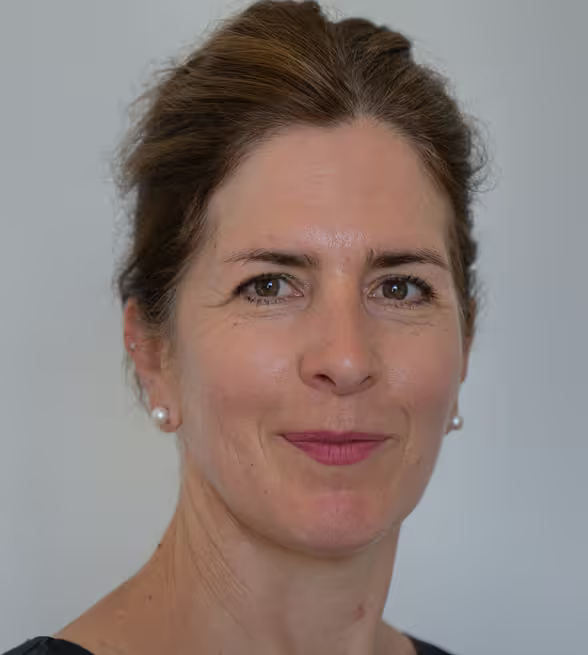
On 31 August 2022, the Federal Council approved the bilateral implementation agreements for Switzerland's second contribution to selected European Union (EU) states. This is an investment in stability, security and prosperity in Europe, as well as a further step on the bilateral path. We discussed this cooperation with Debora Kern (SDC) and Daniel Birchmeier (SECO), who, among other things, work together on the programmes that the contribution will fund in the field.
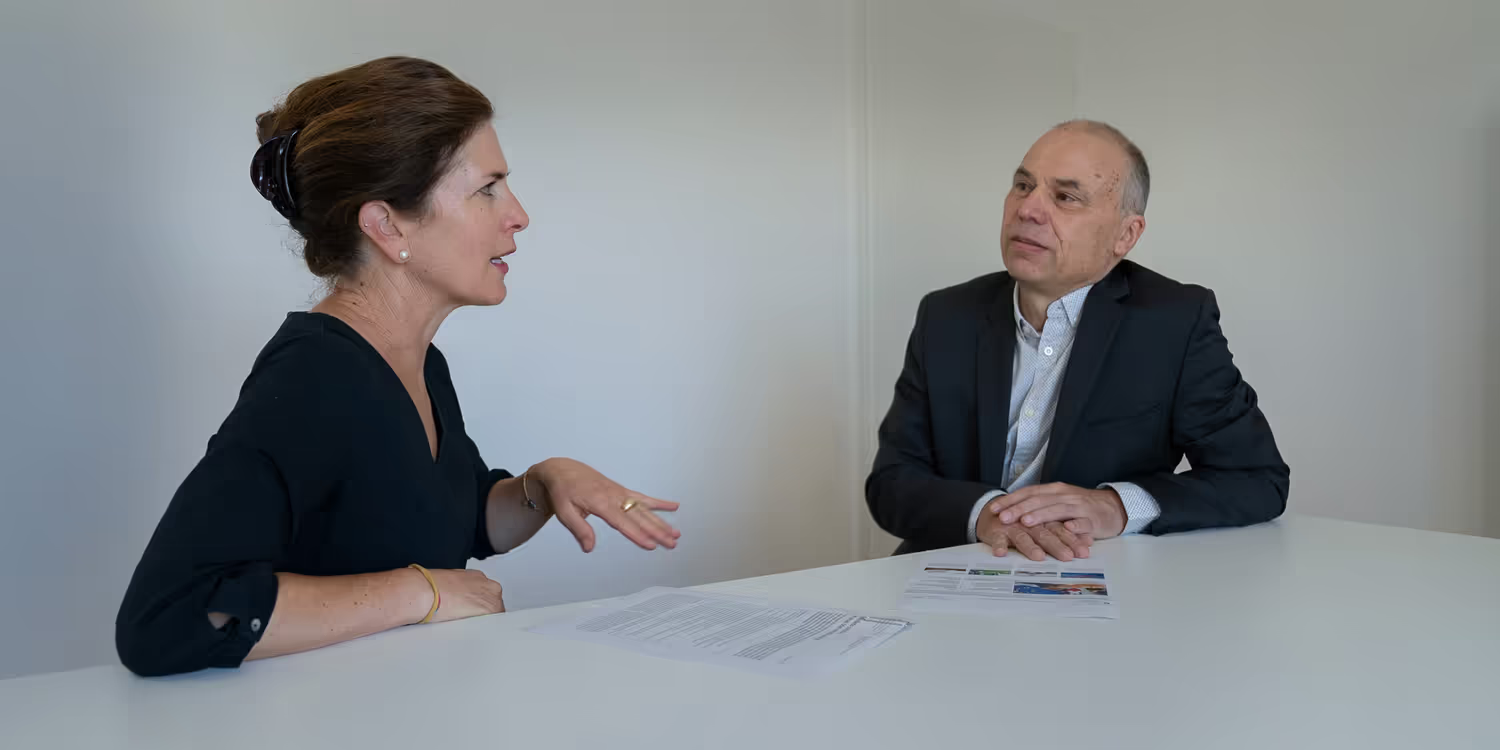
The second Swiss contribution entails an investment of CHF 1,302 million over a ten-year period for countries that joined the European Union after 2004 (EU-13) or are subject to migratory pressure (in a first phase, work will be carried out in particular with Greece, Cyprus and Italy). This investment will be used for selected specific projects and programmes in the partner countries in line with the respective national strategies, and with a twofold objective. «With the second contribution, Switzerland is working to reduce economic and social inequalities in Europe and supporting countries that are under serious migratory pressure,» says Debora Kern, head of the EU Member States Division at the Swiss Agency for Development and Cooperation (SDC).
Projects to ease migratory pressure are financed through the migration framework credit, while those aimed at reducing inequalities in Europe are funded through the cohesion framework credit. The priorities for cohesion include research, environmental programmes, and vocational education and training. «As such, we're making an important contribution to Europe's stability,» says Kern. Moreover, «Switzerland also gets to demonstrate its expertise in a range of areas.» At the same time, the contribution is a European policy and bilateral instrument, explains Daniel Birchmeier, head of the Swiss Contribution to EU Member States/Cohesion Section at the State Secretariat for Economic Affairs (SECO): «Switzerland can use it to strengthen bilateral relations with the partner countries. It also shows that the country is a reliable partner for the EU.»
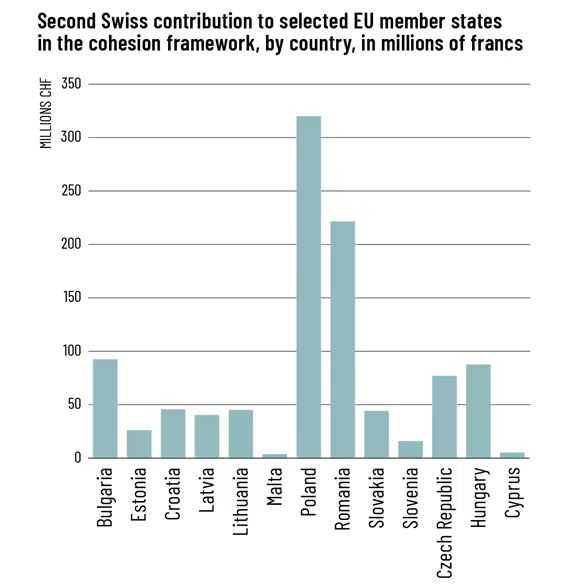
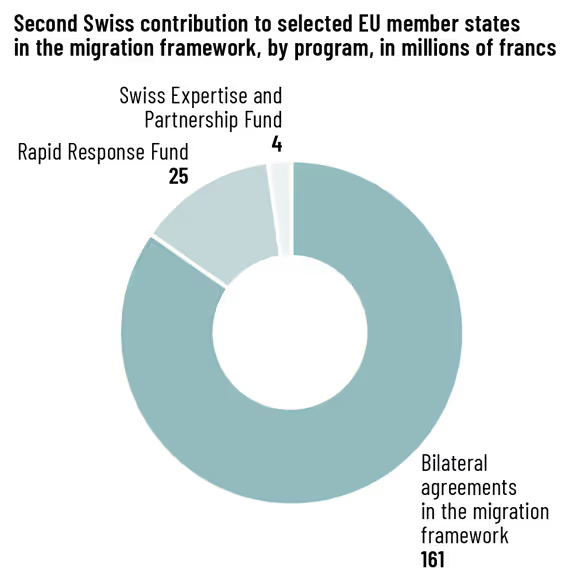
When allocating the cohesion framework credit to the 13 partner countries, Switzerland takes into account factors such as GDP per capita and the size of the population. «Consequently, the needs of economically weaker EU member states are factored in to a slightly greater extent,» explains Birchmeier.
For a brief overview of the second Swiss contribution to selected EU member states, check out the FAQs:
A collective effort
«The State Secretariat for Migration (SEM) is in charge of the migration framework credit, while the SDC and SECO have equal responsibility for the cohesion framework credit,» explains Birchmeier. In the area of cohesion, SECO and the SDC have divided up responsibility for the 13 countries, and the thematic responsibilities are also clearly defined. He continues: «We work very closely and very well together. Where appropriate, we've harmonised our processes and systems. At the strategic and operational level, there are well-established coordination bodies that have been in place for a long time.»
When will the first projects be launched?
Daniel Birchmeier gives us a glimpse behind the scenes as he outlines the next steps in the Swiss contribution. «We reckon we'll be able to start implementing the first projects as early as 2023. The partner countries develop specific programme proposals based on the bilateral implementation agreements.» There is then a two-stage process in which Switzerland examines and approves the proposals. «That may take some time, but it ensures that the projects implemented are of high quality,» he says.
Objectives and shared priorities
Close negotiations with the partner countries are key to the success of the programmes, whose objectives and priorities are shared. «The themes and programmes are chosen on the basis of negotiations,» explains Debora Kern. Switzerland gave the partner countries a choice of 13 thematic areas for cooperation. They then selected the specific areas of cooperation according to their needs. «Of course, the added value in terms of Switzerland's expertise or comparative advantage was an important criterion,» she adds.
While Switzerland plays an important role, so too do the partner countries. «The partner countries participate in all programmes, and usually also make a financial contribution: Switzerland pays up to 85% of the programme cost, with 15% funded by the partner country. We make an exception for projects involving civil society, which is less well-resourced financially. In such cases, we pay up to 100% if necessary.»
Sitting at the same table – and more
The image of people sitting around a big table to find common ground is an evocative one. But is that all there is to it – sitting down with all the partner countries? «Switzerland is conducting separate negotiations with each of the 13 partner countries, so there are differences in the progress and duration of the negotiations,» says Birchmeier. «Since the spring, Debora and I have visited most of the partner countries. This personal contact and the opportunity to find out about potential programmes in situ has accelerated the negotiation process.» As a result, formal negotiations were concluded with eight partner countries by this summer, and SECO and the SDC expect talks with the remaining five countries to be wrapped up soon.
Two examples from abroad
Switzerland's second contribution follows on from its contribution to EU enlargement. That initiative enabled Switzerland to gain considerable experience and generate added value with lasting impact, for example in Bulgaria and Slovenia. «Switzerland supported Bulgaria with a small but strategic programme centred on vocational training,» recalls Kern. The programme involved a reform of the vocational training system and the introduction of the dual system. Bulgaria drafted a new law based on the Swiss model, under which companies hosting trainees and firms in the respective industries were involved in developing school curricula. In this way, the needs of the labour market could be better incorporated into teaching. «The reform is ongoing and not yet complete for all subjects, but a major cornerstone has been laid,» says Kern.
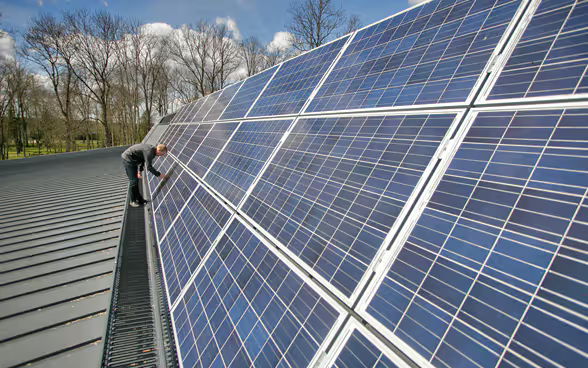
A project that made the biggest impression on Daniel Birchmeier was one in Slovenia. «SECO supported the expansion of renewable energy in Slovenia. Building a noise barrier with solar cells along a section of motorway was part of the project. The barrier is the longest of its kind in Slovenia and generates enough electricity to power all public lighting in the area. This approach is now being rolled out elsewhere in the country,» says Birchmeier, who describes the project as a «small example with charisma throughout the country and lasting impact». Interestingly, he goes on, this summer the Federal Council proposed installing noise barriers with solar cells on sections of Swiss motorway too.
The second Swiss contribution in practice
These and other experiences provided important lessons for designing the second Swiss contribution. «Various evaluations of the implementation of the enlargement contribution confirmed that the basic concept works,» explains Birchmeier. «However, with the second contribution, Switzerland is strengthening the thematic concentration; larger projects will be supported, thereby increasing the efficiency and visibility. We've also decided that, in five smaller countries, only SDC or SECO programmes will be run. With the enlargement contribution, this was only the case in Malta and Cyprus.»
The SDC supports programmes focusing on research, health, vocational education and training, integration, security, the inclusion of minorities, citizen engagement and biodiversity. SECO programmes focus on infrastructure in the environmental and climate protection (water and wastewater, waste management, energy efficiency and renewable energies), urban planning, support for SMEs and tourism. «We work directly with the governments of the countries concerned. Training is improved, public services strengthened, and energy and environmental infrastructure provided,» explains Kern. «A specific example is palliative healthcare, i.e. care for people with incurable, life-threatening or chronically progressive diseases. There is also support for private bodies such as research institutes, SMEs and civil society organisations.»
Thinking long term: European policy objectives
By implementing the second contribution, the Federal Council intends to give fresh impetus to relations with the EU. As such, «the second contribution is part of Switzerland's European policy,» emphasises Kern. It underscores the fact that Switzerland is a supportive partner to the EU, with a vested interest in a strong Europe, she adds. «We're making a tangible contribution to overcoming pan-European challenges such as the migration issue and massive inequalities between countries.» On a more technical note, Birchmeier concludes by highlighting «perhaps the two most important aspects» for Switzerland. «Switzerland boosts its credibility as an active and supportive player, including in Brussels. And in so doing, it strengthens its bilateral relations with the partner countries.»
Four questions to Debora Kern
Contact
General Secretariat GS-FDFA
Federal Palace West
3003 Bern